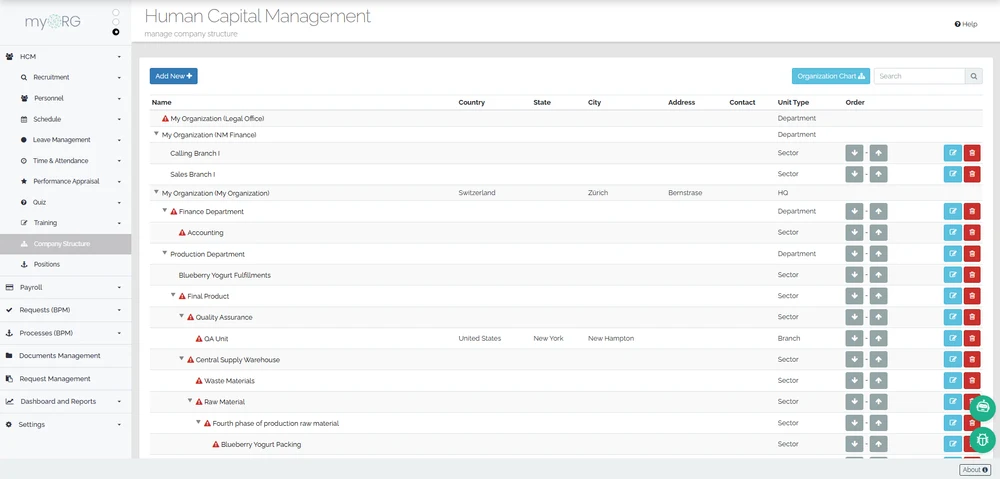
Most HR systems store people. continON HCM stores the organization first: a unit hierarchy of arbitrary depth, positions that report to other positions, and seats — a position bound to a specific unit, with head-of-unit and managerial flags, a clearance level, and a staffing limit. People are assigned to seats through employment records that carry contract numbers, dates, and wage rates, and that keep their history when things change. Access, workflow routing, and notifications across the platform follow the seat, not the individual, so a personnel change does not mean re-wiring permissions.
On top of that model sits the largest functional module in continON. Recruitment runs from an approved staff requisition through vacancies, applications, multi-stage shortlists, timed online tests, and interview panels with per-criterion scoring — and ends with a one-step conversion of the successful applicant into an employee with a live employment assignment. Daily operations run on generated shift rosters with team rotation, browser check-in and check-out, task-linked timesheets with manager approval, and leave requests approved at two levels. Development runs on trainings with syllabi and attendance evidence, a skill taxonomy, and per-unit evaluation periods with configurable questionnaires.
Because HCM shares its organization and people model with every other continON module, the records connect instead of syncing: the timesheet line points at a real task, the payroll run reads the employment assignment’s wage rate, and the employee sees schedule, requests, and pay in the My continON self-service workspace.