

SolutionsMulti-location operations
Every site runs itself. None of them runs a different system.
Warehouses form one tree — a main site with child warehouses under it, which is how branches are modelled. So branch stock, branch transfers and branch dashboards fall out of the structure that already exists rather than needing a separate concept. What is defined once stays defined once; what belongs to a place stays with the place.
- Held by each place
- Stock, sectors and their conditions, gates, slotting, staffing, its own dashboard
- Defined once
- The licence, permission groups, lookups, languages, Builder definitions, the accounts
- Travels between them
- Transfers, in two phases, with in-transit as an actual state
What is defined once, and what belongs to a place.
- The licenceAn encrypted licence file, validated on upload, decides which applications exist for the organization at all. Sites do not each get their own.
- Defined once for the whole organization.
- Permission groupsBundles of application and privilege grants are maintained once and bound to positions in the org chart, so what a site manager may open is decided by the seat they hold, not by where they sit.
- Defined once for the whole organization.
- Lookups, languages and terminologyCategorized lookups give every module its statuses and types from one governed list, and the two-tier localization model lets the organization relabel screens in its own words. One vocabulary, everywhere.
- Defined once for the whole organization.
- Process, form, report and document definitionsA definition is drawn once and interpreted at run time. Every site runs the version that is published — there is no per-site copy to keep in step.
- Defined once for the whole organization.
- The chart of accountsWhatever moves at whichever site, the value of it posts against the same accounts, so the financial picture does not have to be assembled from per-site exports.
- Defined once for the whole organization.
- Address, currency and logoA unit records its own parent, type, country, state, city and address — and carries its own currency and logo. A site is a real place with its own facts, not a filter on a list.
- Held separately by each site.
- Gates, purpose and access termsEach warehouse records a geocoded location, the gates goods pass through, its purpose and its access terms. Transfers and dispatch read those gates.
- Held separately by each site.
- Whether the site runs slotsSlotting is configured per warehouse, so a small depot is not forced to carry the bin discipline of the central site. It is its own setting, not a global switch.
- Held separately by each site.
- Sector conditionsSectors can enforce minimum and maximum temperature and humidity with their own alert rules, because what a site stores decides how it has to be stored.
- Held separately by each site.
- Stock position, and its own dashboardThe stock ledger scopes down to warehouse and sector, and each site has a single-warehouse dashboard with the depth of its own location.
- Held separately by each site.
A branch is a child warehouse with a parent. Because of that, branch stock, branch transfers and branch dashboards are the same records the main site already uses.
What actually travels between sites.
A transfer
An internal move names its source and destination — bin to bin inside a site, or warehouse to warehouse across the network. Because a branch is a child warehouse, supplying a branch is the same transfer record rather than a separate feature.
DispatchedIn transitReceived
Two phases, so stock that has left one site and not yet arrived at the other is an explicit state — with the transport asset and the gate on the record.
A consignment against an internal request
Approved internal requests are fulfilled through the same distribution screen that fulfils sales — supply between units and locations, without inventing a customer to make the paperwork work.
A posting
Accepting goods is what posts them. Wherever that happened, the value lands against the inventory account on the one chart of accounts.
When another site joins.
The record is a warehouse with a parent. There is no separate branch module to switch on, and nothing that was defined once has to be defined again.
It inherits, immediately
- The licence, so its applications exist
- The permission groups, bound to its seats
- The lookups, languages and terminology
- Every published Builder definition
- The chart of accounts
It starts with its own
- Its own address, currency and logo
- Its gates, purpose and access terms
- Its sectors, slots and conditions
- Its staffing records
- Its stock ledger, from zero
Two levels of view, because that is how sites are actually run.
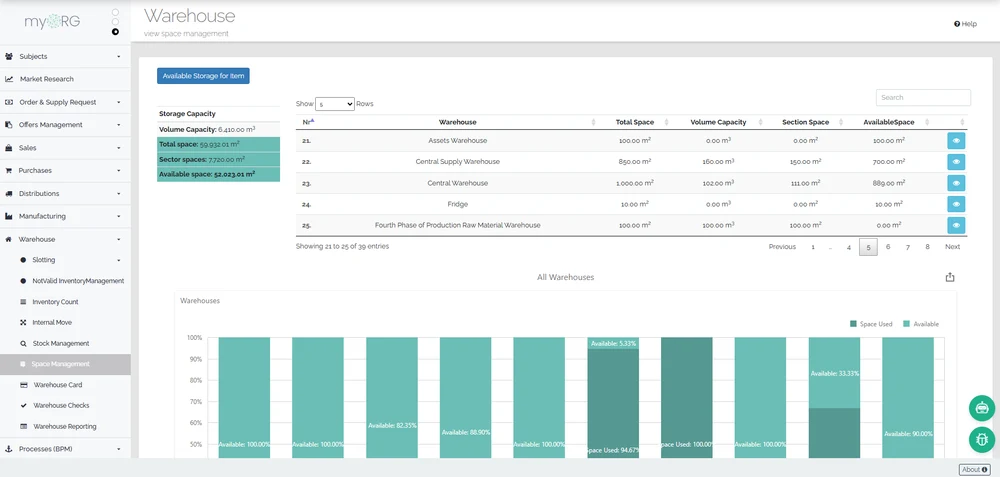
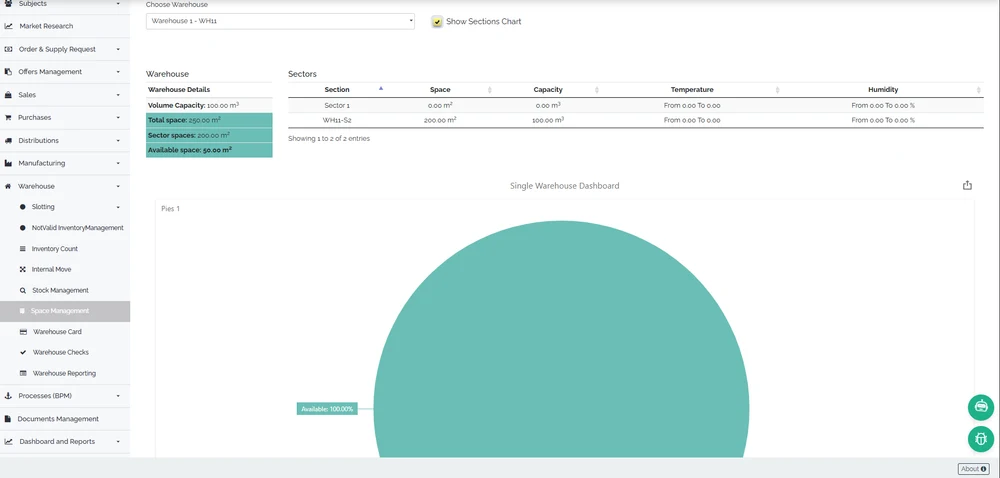
Multi-warehouse network
Bring your second site.
A guided walkthrough on a sanitized demo tenant: a child warehouse added under a main site, a two-phase transfer between them, and the network and single-site views that result.