

Finance & Commercial
Finance & Accounting
continON keeps an operational ledger that fills itself: when a sale, purchase, payment, or cash transaction is recorded anywhere on the platform, paired debit and credit rows land on the right accounts automatically. Around that ledger sit the chart of accounts, a payment subledger with installments and due dates, cash management, currency rates, cost and profit centers, tax settings, and a financial report builder your team configures per organization.
Posts intoThe shared ledger
The operating model
Most operational systems treat finance as an export problem: run the warehouse, then re-key the results into an accounting package. continON treats it as a posting problem. Operational documents carry their financial consequence with them — the moment a sale, purchase, standalone payment, or cash transaction is saved, the platform writes the matching debit and credit rows, including VAT and payment-method amounts, onto accounts resolved from your organization’s own account mappings rather than hardcoded rules.
The module is deliberately scoped as operational finance. It gives the team running the business current visibility of what is owed, what is due, and what is on hand: a filtered general ledger, receivables and payables through one payment subledger, cash records with justification and documents, manually maintained currency rates, tax settings per jurisdiction, and report definitions built from account formulas. It is designed to complement — not replace — a statutory accounting system of record where your jurisdiction requires one.
Because the ledger is shared platform-wide, every row keeps its provenance: a ledger entry knows which sale, purchase, or partner produced it, a damaged-stock write-off in the warehouse posts to an account you chose, and a contract in the register points at the account it settles against. Finance is where the rest of the platform’s activity becomes visible in money terms.
Written by
- Sales
- Purchases
- Payments
- Cash
- Write-offs
Into
The shared ledger
Debit, credit and balance per account
Operational document recorded
A sale or purchase is saved with its items, VAT data, currency, and payment terms.
Accounts resolved
VAT, payment-method, and expense accounts are looked up from your organization’s configured account mappings at posting time.
Ledger rows written
Paired debit and credit rows land in the general ledger with a running balance per account, each row linked back to its source document and partner.
Payments tracked
The payment record carries due date, installments, amount paid, and remaining debt until it is marked paid.
Cash recorded
Incoming, outgoing, and transfer cash transactions are entered against a debit and credit account with justification and attached documents.
Reports evaluated
Configured financial reports compute their sections and components from per-account formulas against the ledger.
In the product
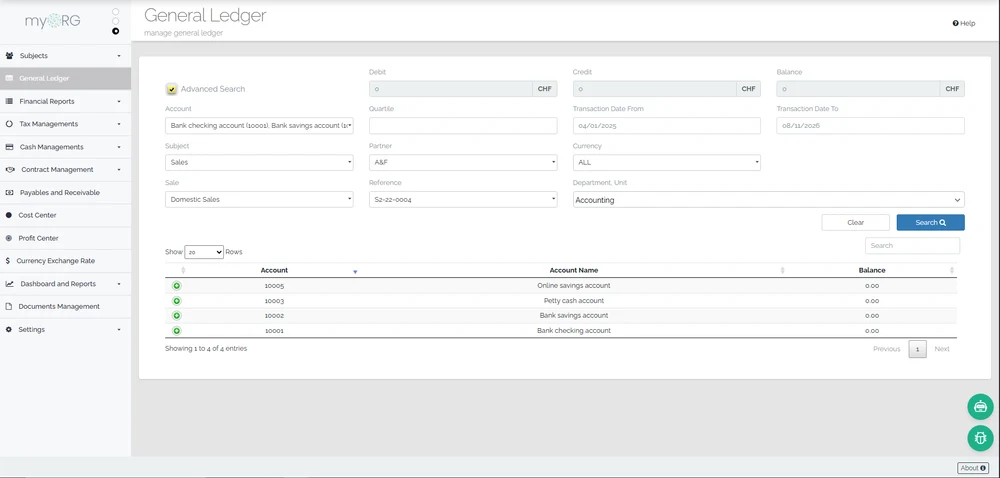
General Ledger screen with account filters and Debit / Credit / Balance columns.
Everything inside Finance
9 capabilities
- Chart of Accounts
How do we set up and maintain the account structure every posting lands on? - General Ledger
Where can we see every debit and credit the operation has produced, account by account? - Automatic Posting
Do the books keep up with operations without re-keying? - Payments (Receivables & Payables)
How do we track what customers owe and what we owe suppliers, payment by payment? - Cash Management
How are cash movements recorded, justified, and tied to accounts? - Currencies & Exchange Rates
How does the platform handle documents in more than one currency? - Cost & Profit Centers
Can we model our controlling structure — who is responsible for which costs and results? - Tax Settings & Obligations
How are tax rates, rules, and deadlines configured per jurisdiction? - Financial Report Builder
Can we define our own financial statements instead of accepting fixed templates?
Connected through one operating model
Finance does not stand alone.
Records cross module boundaries without being re-entered — these are the relationships continON actually maintains.
- Purchasing & Supply
Purchase documents trigger expense-side postings on save. - Sales Management
Sale documents are one of the ledger’s main row sources. - Warehouse Management
Damaged and expired stock write-offs post to an account chosen from this chart. - Orders & Offers
The offer and order records of the commercial cycle: quotations with validity and price tiers, customer orders that reserve stock, and supplier orders built from approved requests. - Contract Management
A contract record links to the account it settles against. - Payroll
Configuration-driven payroll: schemas with income and deduction formulas, tax brackets, calculated period runs, controlled approval, and generated payslips.
See Finance on your own operations.
A guided walkthrough on a sanitized demo tenant — this module, the shared platform, and a connected workflow end to end.