

SolutionsConnect existing systems
Your systems stay where they are. Selected information crosses.
continON does not have to absorb the estate you already run in order to be useful inside it. It can query databases and files you already operate, hold credentials for external services under your organization’s own name, and put what comes back to work in operational records — while the source system remains the source.
The supported ways information can cross
Query a source where it already lives
SQL Server, PostgreSQL, MySQL, Access and other OleDB sources, and shared files. The builder browses the external schema in place and saves a parameterized query as a named object — so you compose against the tables you actually have, not a copy someone exported.
Query & data-source builderRegister an external API under your organization
A named credential — base URL, application id, key — stored encrypted and retrieved by the applications that need it rather than by people. Every request that leaves is signed with the organization key, so the receiving system can tell where it came from.
Integrations & dataUse one of the service integrations that ship
A small set, for operational essentials: transactional email delivery, and calendar and meeting scheduling that creates events with join links. An accounting connector is available in a sandbox configuration ahead of live use.
Platform architecture
Nothing crosses by accident.
A database you already operate
Stays where it is, under its own schema and its own administration.
Crosses asA saved query, composed against that schema
One definition feeds every consumer: a form’s select list, a report’s rows, a dashboard widget, and the merge fields of a generated document. Four screens do not each write their own fetch.
A service you already pay for
Keeps its own accounts, its own limits and its own rules about what it will answer.
Crosses asA credential held by the organization, not by a person
The key is encrypted at rest and fetched at call time by the application that needs it. Nothing is pasted into a screen, and the request that leaves carries a signature the other side can check.
A file share your team already uses
Nobody is asked to move it, rename it, or stop using it the way they do now.
Crosses asA file-based source, read through the same catalog
It resolves into the same saved-query layer as the databases, so it is granted, parameterized and consumed identically. There is not one mechanism for real data and another for spreadsheets.
A system that expects data back from you
Continues to receive it in the format it already understands.
Crosses asExport, and documents generated from your own templates
Operational data leaves as Excel, CSV or PDF, and templates merge a record’s own context into the finished document — which is then filed in the governed store rather than emailed out of a folder.
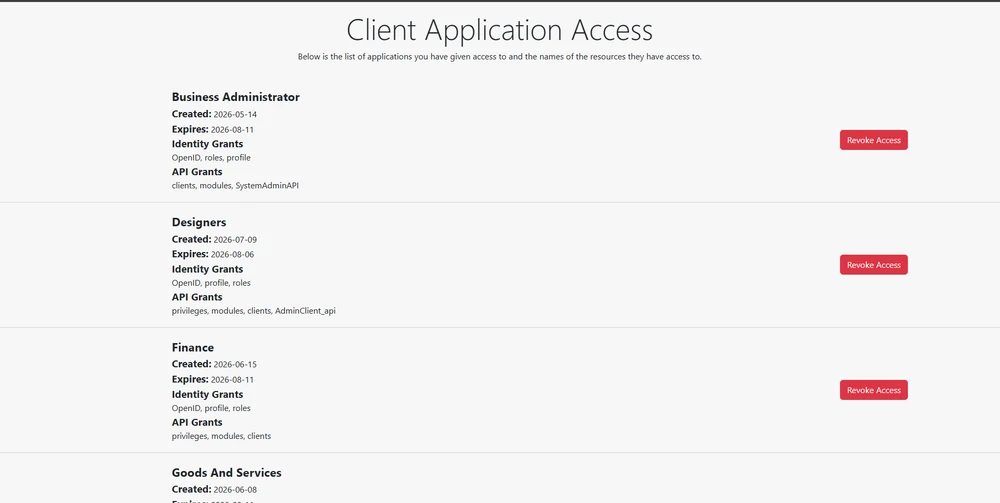
What crosses is named, dated, and revocable.
Access is issued to an application rather than assumed by it. Each grant lists the identity and API scopes it covers, when it was created and when it expires — and carries the control that withdraws it. A connection you cannot see is a connection you cannot govern.
What does not cross.
- There are no inbound or outbound webhooks. Nothing here waits to be called by a system you configure elsewhere.
- There is no generic bulk import of spreadsheets into operational records. Data crosses by being queried or by being entered, not by being uploaded in a batch.
- The accounting connector is configured against a sandbox. It is not presented as a live, production accounting integration.
- Connectors beyond the providers and services named on this page are not claimed. Where something is not built, it stays unsupported until it is.
Replacing a system is sometimes the right decision. This page is about the cases where it is not, and about being specific enough that you can tell which case you are in.
Bring one system you are not replacing.
A guided walkthrough on a sanitized demo tenant: a copy of one of your data sources connected, a saved query built against it, and the same definition feeding a form, a report and a generated document.