

Buildersbuilder
Query & Data Source Builder
Can continON work with the databases and files we already run?
Connect the databases and files you already run — SQL Server, PostgreSQL, MySQL, Access, and shared files — browse their schema, and save parameterized queries as named objects. Forms, reports, dashboards, and document templates all read through those same saved definitions.
How it works
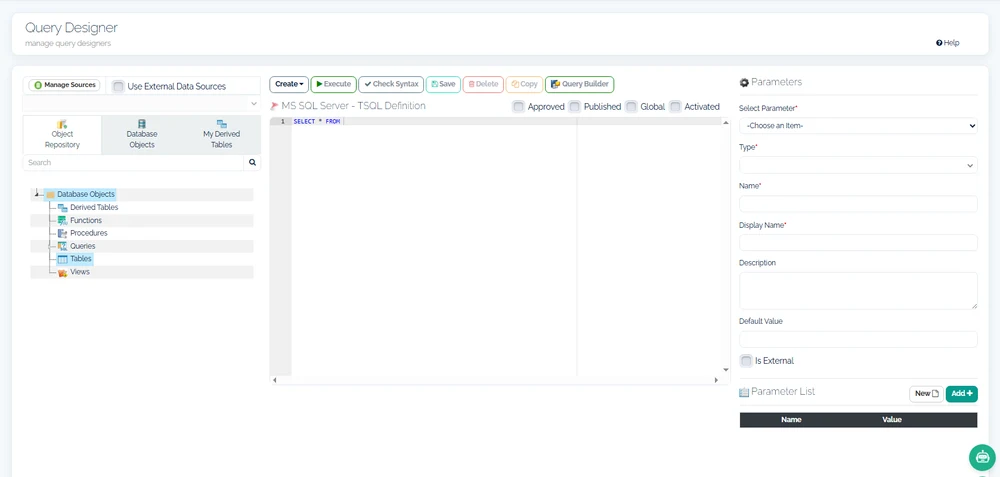
The builder connects to a scoped set of sources: SQL Server, PostgreSQL, MySQL, Access and other OleDB sources, and shared files. It browses the external schema in place, so queries are composed against the tables you actually have rather than a copy someone exported.
What you build becomes a first-class object. Queries, tables, views, functions, and procedures are saved by name into a shared catalog, and their parameters are supplied at run time by whatever calls them — a form filling a select list, a process running a step, a report rendering, a template merging a document. One definition serves every consumer instead of each screen re-implementing its own fetch.
It also includes a table designer that writes real schema. Define columns and constraints and the builder generates and applies the change — foreign keys included — inside your organization’s own schema namespace. That is genuine SQL generation, and it is one reason continON describes the Builders as configuration you can extend rather than a no-code tool.
What you define, and what runs
A scoped, honest provider list
SQL Server, PostgreSQL, MySQL, Access/OleDB, and shared files — the providers actually implemented, not a claim of connecting to anything.
Browse external schema
Inspect a connected source’s tables and columns from inside the designer before building against them.
Parameters bound to context
A saved query accepts parameters — including the request, process, and employee identifiers of the record that runs it.
Saved objects, referenced by name
Queries, tables, views, functions, and procedures live in one catalog every other Builder resolves against.
A table designer that writes schema
Column and constraint definitions generate and apply real DDL, transactionally, into the organization’s own namespace.
Drop to SQL when needed
Hand-write SQL for the cases a visual designer cannot express — a stated part of the model, not an exception to it.
What this touches
- Form Builder
Form fields, lookups, and submit actions resolve through saved queries. - Report Designer
Reports render from the same saved queries, so counts match what forms captured. - Dashboard Designer
Dashboard widgets bind to saved queries or ad-hoc SQL from this catalog. - Document Template Designer
Templates merge the fields of a bound query into generated documents. - Integrations & data
Database and file connections live here; per-organization external API credentials are managed under integrations.
See query & data source builder running in continON.
A guided walkthrough on a sanitized demo tenant — this capability inside its module, on the shared platform.