

PlatformOrganization
A unit is a place. A position is a definition. A seat is one placed in the other.
Most systems store people and attach a hierarchy afterwards, which is why access drifts every time somebody moves. continON models the organization first, as four objects that are deliberately not the same thing — and then points permissions, documents, reports, workflow and notifications at the third of them.
Why four objects and not two If a job were only ever a row on a person, there would be nothing left to hold the access when the person goes. Separating the definition from its placement, and the placement from its occupant, is what lets the organization keep working while people change.
The four objects, at the depth each one actually sits.
Unit
A place in the organization. Every unit has one parent, so the whole company is one tree that can nest as deep as it needs to.
- A unit type, so a branch and a department are not the same kind of thing
- A location, and a flag for whether the location operates independently
- Its own currency, where the unit trades in one
- A head of unit, resolved from the seats inside it
Position
A definition of a job, held at the level of the whole organization. On its own it is not anywhere: it has no unit, and nobody holds it.
- A title, and who the position reports to as a definition
- A pay grade and base pay
- The responsibilities the job carries, written once
Seat
The same position, placed into a specific unit. This is the object almost everything else in continON actually points at.
- Its own reporting line inside that unit’s org chart
- Whether it is the head of that unit, and whether it is managerial
- A clearance level
- How many people may hold it at once
Assignment
A person placed into a seat for a period. The assignment is dated and kept, so the organization does not lose who held the seat last year.
- The employee, the seat, the unit and the manager, tied together
- Contract number and dates
- Which assignment is the current one
One position, placed three times, is three seats.
The definition is written once. Placing it into a unit creates a seat that belongs to that unit and carries that unit’s answers — its reporting line, whether it heads the unit, its clearance, and how many people may hold it. Three placements of one definition are three different objects, and access is granted to them separately.
The definition
Warehouse Supervisor
Reports to Operations Manager · pay grade set once · responsibilities written once
Central warehouse
Seat
Heads the unit · clearance raised · one holder
Northern depot
Seat
Reports to the depot manager · two holders on shift
Returns centre
Seat
Not managerial · one holder · standard clearance
The example above is written to show the relationship. What a unit is called, how deep the tree goes and what each seat carries are yours to define — continON supplies the objects and the rules that connect them, not a reference org chart.
Five things resolve against the seat rather than the person.
Application and module permissions
Permission bundles are granted to a seat. Whoever holds it inherits them; when they leave it, they do not take them.
How authority resolvesDocument access
Folder and file rights are granted to a seat, and resolve to whoever currently holds it.
The document serviceReport and dashboard access
Reports and dashboards carry their own grants, issued to seats and to partners rather than to individuals.
Workflow actors
A process step does not name a person. It names a relationship — the initiator, their supervisor, the head of unit, or a named group of seats — and the engine resolves it when the request arrives.
A definition becoming behaviourNotifications and reminders
Recipients are worked out from seat and unit, so a rule written once keeps reaching the right people after a reorganisation.
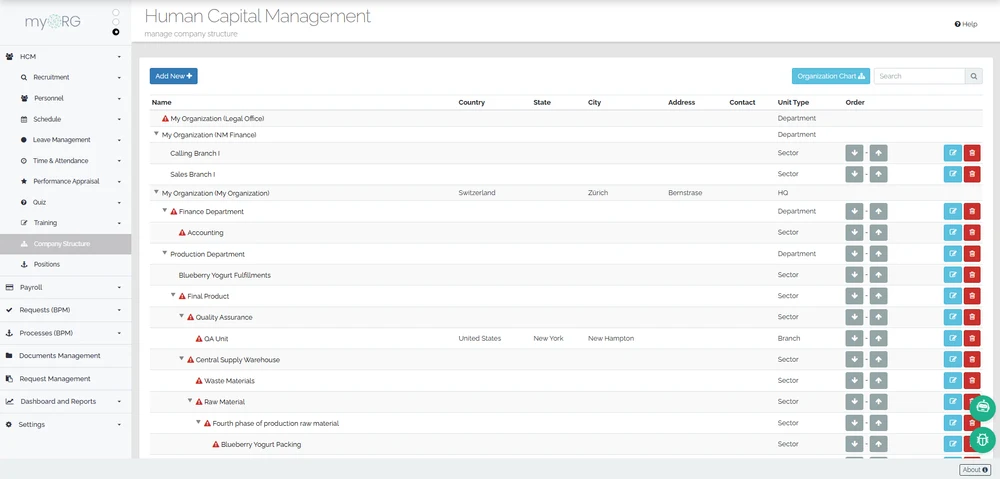
The tree, in the product.
Units nested by department, sector and branch, each row carrying the country, the city and the unit type it was defined with. This is the structure every other page in this family points back to.
Model one unit and one seat on your own chart.
We will place a position into a unit on a sanitized tenant, grant something to the seat, and then move a person out of it — so you can see what stays and what goes.